1. What is a Pylon Sign? Definition, History, and Taxonomy
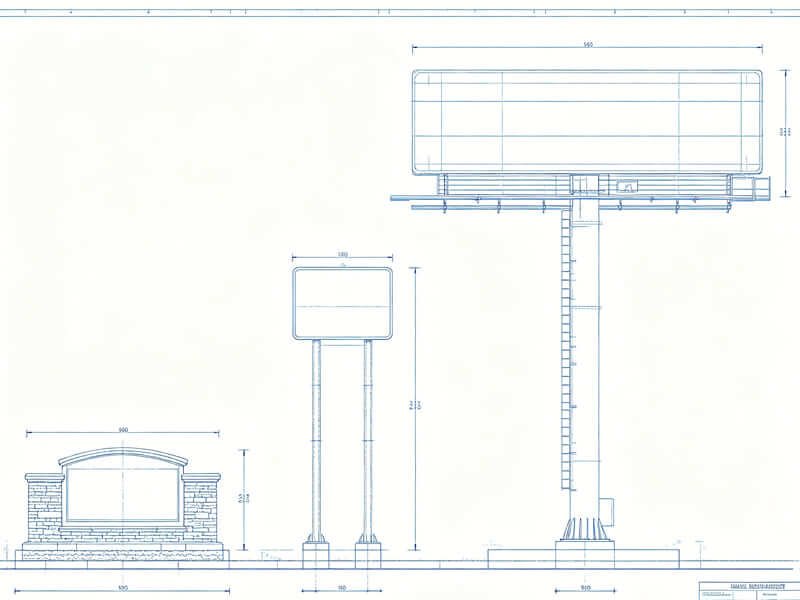
Before we dive into the technical details, we must establish a clear definition. A pylon sign is a freestanding structure that stands independently of any building, supported by one or more poles or a structural steel frame. In the signage industry, these are often referred to as “road signs,” “highway signs,” or “totems.” Their primary purpose is to elevate your brand message above the “visual noise” of the street, ensuring that drivers can see you from a significant distance.
The Evolution: From Temples to Interstates
The concept of reaching for the sky to mark a location is thousands of years old. The word “pylon” is derived from the ancient Greek word pyle, meaning an entrance gate. In ancient Egypt, massive masonry towers known as pylons flanked the entrances to sacred temples, signaling power and authority to everyone who approached. While we no longer use them to guard temples, modern pylon signs serve a similar psychological purpose. They act as the “gates” to your business empire, establishing legitimacy and professionalism the moment a customer enters your territory.
Pylon vs. Monument vs. Pole Signs: Clearing the Confusion
One of the hardest parts for a business owner is understanding the vocabulary. People often use these terms interchangeably, but choosing the wrong structure for your speed zone can be a costly mistake. At a Custom Signage Factory, we categorize them based on height and viewing intent:
| Sign Type | Mounting Style | Standard Height | Primary Audience |
|---|---|---|---|
| Monument Sign | Ground-level base | 3 to 10 feet | Pedestrians & low-speed urban traffic |
| Pylon Sign | One or two tall poles | 15 to 80 feet | Motorists on arterial roads & highways |
| Pole Sign | Bare, exposed pole | 15 to 40 feet | Budget-conscious roadside businesses |
| Hi-Rise Sign | Heavy steel truss | 100+ feet | High-speed interstate travelers |
A Monument Sign is like a piece of landscaping; it is beautiful up close but invisible at 60 mph. A Pylon Sign, however, is a landmark. It is designed to be seen from blocks—or even miles—away. Within the pylon family, you have different “sub-species.” Single-Pole Mounts offer a classic, economical look. Twin-Pole Mounts provide the rigid stability needed for massive sign faces. Finally, Covered-Pole (or monolithic) designs use decorative cladding to hide the steel, making the sign look like a solid, modern tower that complements your building’s architecture.
2. The 9 Strategic Benefits of High-Reach Signage
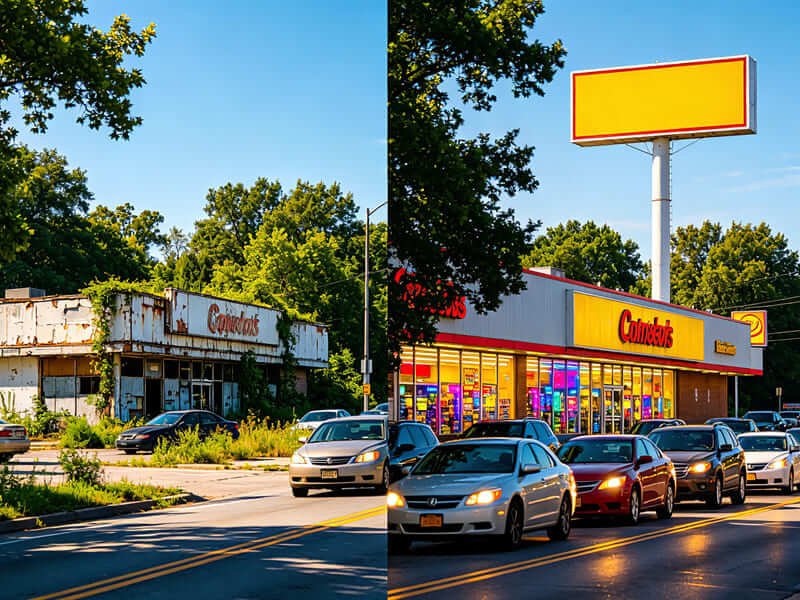
Why should you invest in a pylon sign instead of a cheaper wall sign? It comes down to a fundamental law of physics: you cannot sell to a customer who doesn’t know you are there. Let’s explore the nine core reasons why high-reach signage is a game-changer for business ROI.
1. Maximum Visibility Reach
This is the most obvious benefit. A pylon sign allows you to rise above the clutter. Whether it’s a nearby highway overpass, a row of mature trees, or a competitor’s oversized building, height allows your message to travel in a straight line to the driver’s eye. If your building is 200 feet from the street, a pylon sign effectively moves your front door 200 feet closer to the road.
2. Capturing Impulse Decisions
According to studies by the California Sign Association, nearly 35% of drive-thru and retail traffic comes from impulse stops. A driver sees your sign, realizes they are hungry or need a specific service, and makes a split-second turn. If your sign is only visible 50 feet before the entrance, the driver won’t have time to react safely. A tall pylon gives them the “decision distance” they need.
3. Establishing Legitimacy and Authority
There is a powerful psychological effect associated with height. We naturally associate tall, permanent structures with successful, established organizations. A towering pylon sign made with high-quality materials from a Custom Signage Factory tells the community that you are here to stay. It removes the “fly-by-night” worry that customers often have with new businesses.
4. The 24/7 Silent Salesman
Unlike digital ads that only show up when someone is browsing, or TV commercials that can be skipped, a pylon sign is a constant presence. It is always working. When it is illuminated at night, it becomes a beacon of safety and service, guiding customers to your door even when you are closed, reinforcing your brand in their memory for their next trip.
5. Superior Cost Per Thousand (CPM)
If you compare the one-time cost of a pylon sign to the recurring monthly lease of a highway billboard, the pylon wins every time. You own the asset. Over a 20-year lifespan, the cost per view is lower than almost any other form of advertising, including search engine marketing.
6. Supporting Multi-Tenant Leasing
For property developers, a multi-tenant pylon sign is an essential leasing tool. It provides equal exposure for every brand in your plaza, increasing the value of your commercial space. Tenants are more likely to sign a long-term lease if they know their name will be seen by 50,000 cars a day.
7. Brand Consistency and Cohesion
A pylon sign acts as a physical anchor for your brand identity. By using the exact Pantone colors and logo shapes provided by your factory, you ensure that your physical location matches your website and social media. This consistency builds deep trust with your audience.
8. Navigational Clarity
In large industrial parks or sprawling shopping centers, a pylon sign is a vital wayfinding tool. It prevents “lost customer frustration” by clearly marking the entrance. A well-placed sign reduces traffic accidents in your parking lot by giving drivers clear instructions well in advance of the turn.
9. Winter and Weather Advantage
In regions that experience heavy snow or fog, ground-level signs often get buried or obscured. A tall pylon sign stays visible through the toughest winter conditions, ensuring your business stays “open for business” in the eyes of the public regardless of the season.
“A pylon sign is more than just a marker; it is an investment in your company’s physical presence. It turns your location into a destination.”
3. Engineering and Structural Integrity: The Factory View
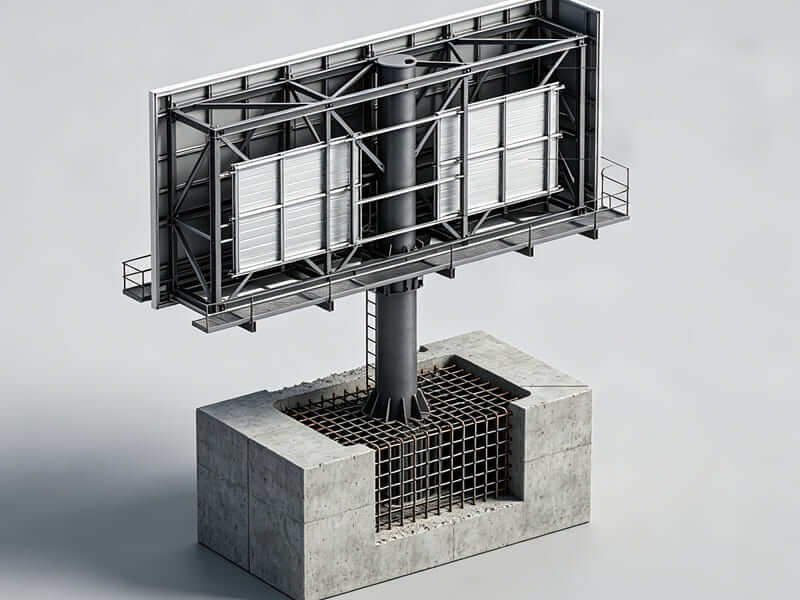
When you look at a pylon sign, you see a beautiful brand logo. When an engineer at a Custom Signage Factory looks at it, they see a complex machine that must survive 20 years of environmental abuse. Because pylon signs are freestanding and reach high into the air, they face forces that would easily crush a standard wall sign. Let’s look at the “hidden” science that keeps these towers standing.
The Science of Wind Load
The most dangerous enemy of a pylon sign is the wind. A 20×10 foot sign face acts like a massive sail on a ship. In a storm with 90 mph winds, that sign face can experience thousands of pounds of lateral pressure. If the “moment of force” isn’t handled correctly, the pole will snap or the sign will be ripped off its base. Engineers use specialized software to calculate the exact thickness of steel needed for the main support poles. For example, in coastal regions, we often engineer signs to withstand a 150 km/h (93 mph) wind rating, which requires hot-dip galvanized structural steel frames.
Foundation: The Hidden Strength
A pylon sign is only as good as the ground it sits on. The “foundation” or “footing” is a massive underground concrete structure. Depending on the height of the sign and the soil quality, we might dig a hole 10, 20, or even 30 feet deep. In cold climates like Canada or the Midwest, these foundations must go below the “frost line.” If they don’t, the ground will freeze and expand, pushing the sign up and causing it to lean or crack. We use heavy-duty anchor bolts—sometimes 2 inches thick—to secure the steel pole to the concrete base.
Materials Matter: Aluminum vs. Steel
A professional factory uses a combination of materials to balance strength and weight.
- The Frame: We use structural steel for the skeleton. To prevent rust, the steel is painted separately from the outer “skins” using rust-inhibiting primers.
- The Cabinet: The outer shell is usually made of .063 gauge aluminum. Aluminum is the king of signage because it is naturally rust-proof and very light. This prevents “oil-canning”—a term for when thin metal warps and looks like a crushed soda can under the sun.
- The Faces: For the graphics, we use Acrylic or Polycarbonate (Lexan). Acrylic gives the best color clarity, but Polycarbonate is 30 times stronger. If your sign is in an area with high winds or vandalism, Lexan is the only choice because it won’t shatter if hit by a rock or flying debris.
| Engineering Element | Standard Specification | Safety Benefit |
|---|---|---|
| Main Support | Schedule 40 or 80 Steel Pipe | Resists bending and structural failure |
| Internal Coating | Hot-Dip Galvanizing | Stops rust from destroying the sign from inside |
| Outer Skin | Powder-Coated Aluminum | Maintains brand color and resists corrosion |
| Face Material | UV-Stabilized Polycarbonate | Prevents cracking, yellowing, and impact damage |
| Foundation | Reinforced Concrete Pier | Transfers wind load safely into the earth |
Certified Welding and Fabrication
At the Custom Signage Factory, every joint is critical. We use certified welding techniques to ensure that the steel skeleton can handle the vibration and stress of a 20-year lifespan. After welding, the entire structure is cleaned, degreased, and primed before receiving a two-part acrylic polyurethane finish. This is the same type of paint used on high-end luxury cars, ensuring that your sign looks brand new even after a decade of rain, salt, and sun.
4. Design Science: The “30-40% Rule” and the Legibility Index
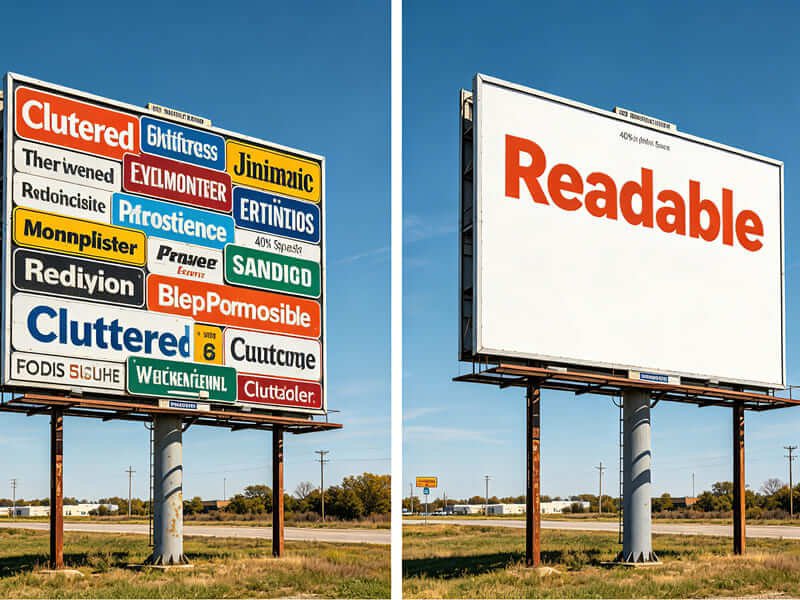
Having a tall sign is only half the battle. If your customers can’t read it, you’ve just built an expensive piece of sky-art. At the Custom Signage Factory, we treat sign design as a branch of optical science. When a driver is moving at high speeds, their brain is filtering out 90% of what they see. To get into that remaining 10%, your sign must be designed for instant comprehension.
The Power of the 30-40% Rule
One of the biggest mistakes I see business owners make is trying to turn their sign into a brochure. They want to list their phone number, their website, their founding year, and every service they offer. Don’t do this. Experts from cities like Walnut Creek and Arcadia emphasize the 30-40% Rule: At least 30% to 40% of your sign face should be “white space” or empty space. This empty space acts as a visual frame. It allows the viewer’s eye to lock onto the most important information—your name and logo—without being distracted by “visual noise.”
The Legibility Index: Sizing for the Speed Limit
How big should your letters be? This isn’t a matter of opinion; it’s a matter of safety. A driver moving at 45 mph needs enough time to see the sign, read it, and safely signal for a turn. We use a standard called the Legibility Index. Generally, every 1 inch of letter height provides about 10 to 40 feet of readable distance. However, for highway signs, we always push for the higher end of that scale.
| Traffic Speed (MPH) | Required Viewing Distance | Recommended Letter Height | Reaction Time (Approx.) |
|---|---|---|---|
| 25 MPH (Urban) | 150 Feet | 6 to 8 Inches | 4 Seconds |
| 45 MPH (Arterial) | 400 Feet | 12 to 15 Inches | 6 Seconds |
| 65 MPH (Highway) | 800 Feet | 24 to 30 Inches | 8 Seconds |
| 75 MPH (Interstate) | 1,000+ Feet | 36 to 48+ Inches | 10 Seconds |
Color Contrast and Typography
Contrast is your best friend. The human eye sees contrast before it sees color. This is why a yellow sign with black letters (like a school bus) is so effective. Avoid “vibrating” color combinations like red text on a blue background; the colors clash in a way that makes the text look like it’s shaking, which is very hard to read from a distance. Also, stick to Bold Sans-Serif fonts. Fancy, thin, or script fonts disappear when viewed at 50 mph. Use fonts like Helvetica, Arial, or Verdana for maximum impact.
5. Lighting and Digital Integration: Glowing 24/7
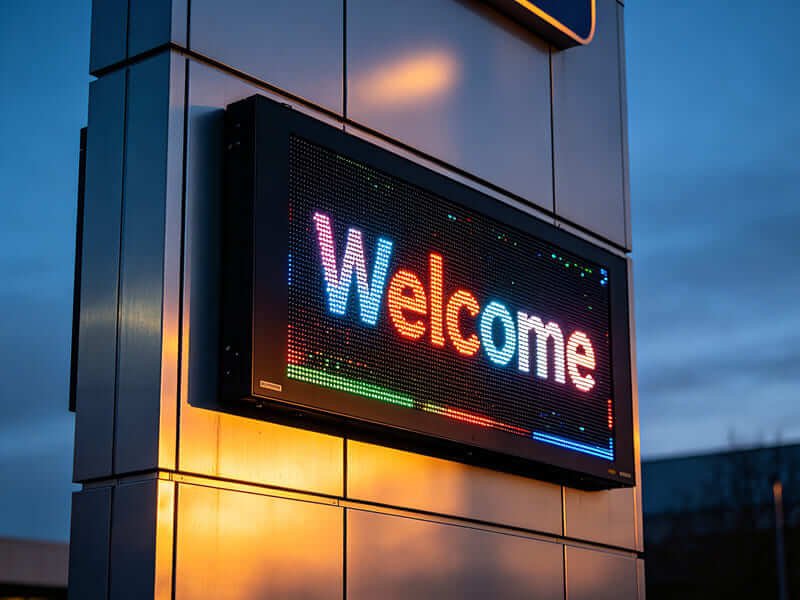
Visibility shouldn’t end when the sun goes down. In fact, for many businesses like gas stations, hotels, and restaurants, the night is their most profitable time. Modern lighting technology has evolved far beyond the old flickering fluorescent tubes of the 1980s. Today, the Custom Signage Factory focuses on LED (Light Emitting Diode) systems and Electronic Message Centers (EMCs).
Why LEDs Won the War
LEDs are the gold standard for several reasons. First, they use 60% to 80% less energy than traditional lamps. Second, they perform perfectly in the cold—fluorescent bulbs often struggle to light up in freezing temperatures. Finally, LEDs last for about 100,000 hours. That is over 11 years of continuous nighttime use without needing to hire a bucket truck for repairs. For a B2B project, this reliability is the difference between a high-value asset and a maintenance nightmare.
Electronic Message Centers (EMCs)
If you really want to stand out, you need a digital display. An EMC allows you to change your message instantly from your computer or smartphone.
- Nits (Brightness): For a sign to be visible in direct sunlight, it needs to be “sunlight-readable,” usually around 5,000 to 7,000 Nits.
- Automatic Dimming: Most cities require that digital signs dim automatically at night to prevent blinding drivers. We use light sensors (photocells) to handle this automatically.
- Pixel Pitch: This is the distance between the LEDs. A smaller pitch means a higher resolution. For pylon signs that are viewed from far away, an 8mm to 16mm pitch is usually the perfect balance of cost and clarity.
Aesthetic Lighting: Halo and External
Not every sign needs to be a glowing box. For high-end office parks or luxury hotels, Halo Lighting (also called Reverse-Lit) is very popular. The light shines out the back of the letters, creating a soft, sophisticated glow against the sign’s surface. If you have a carved wood or stone sign, External Lighting like gooseneck lamps or ground-mounted spotlights can create a classic, welcoming feel.
6. Powering Up: The Professional Electrical Roadmap
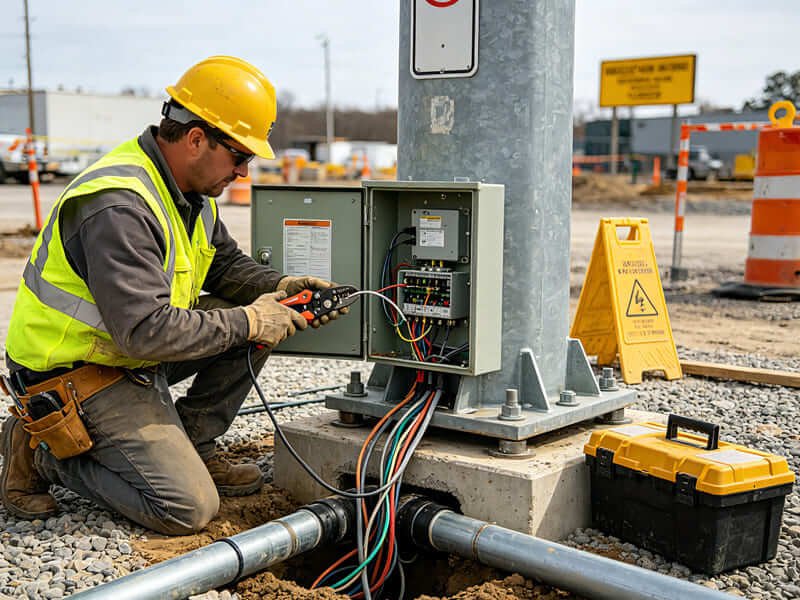
One of the biggest causes of delay in a sign project is the electrical “rough-in.” As a business owner, you need to understand the “Division of Labor.” I always tell my clients to think of it like building a house: the electrician builds the road, and the sign company drives the car onto it.
The C-10 vs. C-45 Licensing Rule
Contracting licenses are very specific. A local electrician (holding a C-10 license) is the only person allowed to run primary power lines across your parking lot. They must run a dedicated 120V, 20-amp circuit from your building’s main panel to the sign’s location. The sign manufacturer (holding a C-45 license) is responsible for the sign itself. Once the electrician leaves a “Junction Box” (J-Box) within 5 feet of the sign, the sign crew can take over and make the final connections.
The Must-Have Component: Astronomical Timers
To pass city inspections and save money on your electric bill, you should use an Astronomical Timer. A standard timer just turns on at 6 PM every day. But the sun sets at different times in January than it does in June. An astronomical timer uses your specific GPS coordinates to know exactly when the sun rises and sets every day. It automatically adjusts itself so your sign is never dark when it should be glowing, and never wasting money during the day. This is often a requirement for energy codes like California’s Title 24.
“Communication is key. The best way to ensure a perfect install is to connect your sign manufacturer with your electrician early in the process. We speak the same technical language and can prevent mistakes before they happen.”
7. Navigating the Legal Landscape: Permits and Zoning
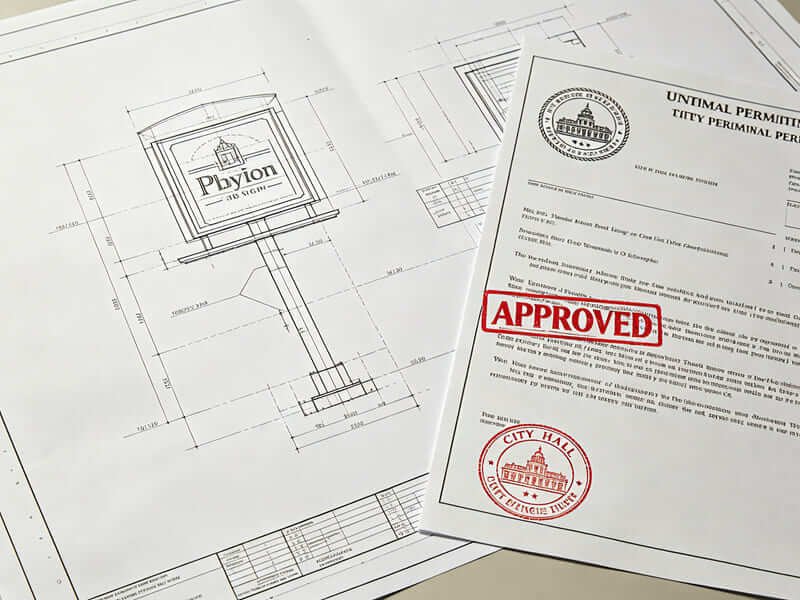
You cannot just put a 50-foot tower wherever you want. Signs are treated as part of the public infrastructure, and every city has a “Sign Ordinance.” If you ignore these rules, the city can force you to tear the sign down at your own expense. This is why a Site Survey is the most important first step at the Custom Signage Factory.
The Vision Clearance Triangle
Safety is the top priority for city planners. Almost every city (like Arlington, TX) enforces a “Vision Triangle” rule. This is a 10-foot leg triangle at the corner of an intersection or a driveway. To make sure drivers can see oncoming traffic, you cannot place any sign over 3 feet tall within this triangle. If your pylon sign is massive, the pole must be set back behind this zone to keep the sightlines clear.
Height and Setback Limits
Depending on your zoning (Commercial, Industrial, or Residential), the city will limit how high your sign can be. Along a major highway, you might be allowed 60 or 80 feet. In a historic downtown, you might be limited to 15 feet. You also have to follow Setback rules, which usually state that your sign must be at least 5 to 12 feet away from the property line. We handle the permit acquisition for our clients, dealing with the city hall red tape so you don’t have to.
8. The Buying Roadmap: Global Sourcing and Logistics

If you are looking for high-quality signage at a competitive price, sourcing from a professional Custom Signage Factory is a smart move. But how do you get a 40-foot sign from the factory to your parking lot? The secret is Modular Design and Export Packaging.
Phase 1: Assessment and Shop Drawings
We start by looking at your site photos and your local codes. Our designers create detailed “Shop Drawings.” These are technical blueprints that show every weld, every LED module, and the structural steel requirements. We ensure the sign matches your brand colors perfectly using automotive-grade paint systems like Matthews Paint.
Phase 2: Modular Fabrication
Large pylon signs are heavy and difficult to ship as one piece. We use a “knock-down” or modular approach. We build the sign in sections—the main pole, the cabinet, the decorative cladding, and the faces. Each piece is engineered to fit perfectly into a standard shipping container. This reduces shipping costs and protects the sign from damage during transit.
Phase 3: Global Logistics and Installation
We have years of experience shipping oversized items worldwide. We use reinforced steel frames and export-grade wooden crates to ensure your sign arrives in perfect condition. Once it arrives, we provide your local installers with a full set of assembly instructions, foundation templates, and wiring diagrams. This makes the final setup as simple as putting together a giant Lego set.
9. Maintenance and Long-Term Value

A pylon sign is a long-term capital investment. If you take care of it, it will look brand new for 20 to 30 years. Neglect it, and it will start to signal that your business is “tired” or “unsuccessful.”
Annual Cleaning and Inspection
I recommend a professional cleaning once a year. Dust, car exhaust, and salt can eat away at the UV coating on your paint. A simple wash with mild soap and water goes a long way. During this cleaning, you should also do a “Check-Up.”
- Structural: Check for any loose bolts or rust spots on the pole.
- Electrical: Open the access panel and check for any signs of water or insect nests.
- LEDs: Replace any dim or flickering modules immediately to keep your branding crisp.
The LED Retrofit: Saving Your Old Sign
If you have an existing pylon sign that uses old fluorescent bulbs, you are wasting money. We can help you perform an LED Retrofit. You keep the existing steel structure and sign faces, but we replace the “innards” with modern LEDs. This typically pays for itself in just two years through energy savings and by eliminating the need to pay for a crane truck every time a bulb burns out.
10. Strategic Comparison: Pylon vs. Monument vs. Wall Signs
To help you make the final decision for your property, here is a breakdown of how different sign types perform in the real world.
| Sign Type | Visibility Range | Initial Investment | Typical Lifespan | Best For… |
|---|---|---|---|---|
| Pylon Sign | 1/4 to 1 Mile | Moderate to High | 25-30 Years | Highway traffic, Shopping Plazas |
| Monument Sign | 100 – 300 Feet | Moderate | 20-30 Years | Corporate Entrances, Medical Parks |
| Wall Sign | Sidewalk Range | Low | 10-15 Years | Retail Facades, Urban Downtowns |
| Hi-Rise Pole | 2+ Miles | Very High | 30+ Years | Truck Stops, Interstate Gas Stations |
| EMC (Digital) | High Impact | High | 10 Years (Screen) | Promotions, Rotating Messages |
People Also Ask: Pylon Sign Strategic FAQ
1. How much does a pylon sign really cost?
Costs are project-specific. A simple 20-foot single-pole sign might start around $5,000, while a massive 80-foot multi-tenant tower with full-color digital screens can exceed $200,000. It’s best to think of it as a long-term marketing asset rather than a one-time expense.
2. How long does the whole process take from start to finish?
A typical pylon sign project takes between 8 and 12 weeks. Most of that time is actually spent on city permits and structural engineering. The actual factory production usually takes about 3 to 4 weeks.
3. Do pylon signs require a special foundation?
Yes! Because of their height and wind-load, they require a deep concrete pier foundation. In cold climates, this foundation must go below the frost line (usually 36-48 inches) to prevent the ground from shifting the sign.
4. Can I change the logos on a multi-tenant sign easily?
Absolutely. We build these signs with modular tracks. When a tenant leaves, you just slide out the old acrylic panel and slide in a new one. It takes less than 10 minutes and doesn’t require a professional sign crew.
5. What is the difference between Acrylic and Polycarbonate faces?
Acrylic looks beautiful and is very clear, but it can crack. Polycarbonate (Lexan) is virtually unbreakable. If your sign is in a high-wind area or a place with potential vandalism, Lexan is the better choice.
6. Does my sign need a Professional Engineer (PE) seal?
In most municipalities, any freestanding sign over 8 feet tall must have construction plans signed and sealed by a Professional Engineer. This ensures the structure is safe for the public.
7. Why is my pylon sign flickering at night?
This is usually an electrical issue. It could be a failing power supply (transformer) or the fact that the sign is sharing a circuit with another heavy appliance. Remember, a dedicated 20-amp circuit is the industry standard.
8. Are pylon signs better than billboards?
Billboards are for broad advertising. Pylon signs are “on-premise” signage. A pylon sign is more effective because it captures customers exactly when they are at your front door, leading to an immediate sale.
Conclusion: Turning Your Visibility into Value
Throughout this master guide, we have explored why height, reach, and clarity are the most powerful forces in physical marketing. A pylon sign is more than a piece of steel and light; it is your business’s first handshake with the community. It is a bold statement that says you are established, reliable, and here to stay. By following the science of the 30-40% rule, investing in high-grade structural engineering, and preparing your site for professional electrical standards, you turn your location into a landmark.
In a world of digital distractions, a towering pylon sign is one of the few ways to grab attention in the real world. It works for you 24 hours a day, through every season and every storm. When you partner with a specialized manufacturer who understands the complexities of global logistics and engineering, you gain more than a product—you gain a competitive advantage that pays for itself year after year.
At Custom Signage Factory, we are passionate about helping brands stand tall. From our precision CNC cutting to our certified welding and export-grade packaging, we ensure your vision is realized with the highest quality. Whether you are building a single gas station or a massive retail corridor, we have the expertise to make your brand impossible to miss.