The Big Picture – Why is Airport Wayfinding So Crucial?
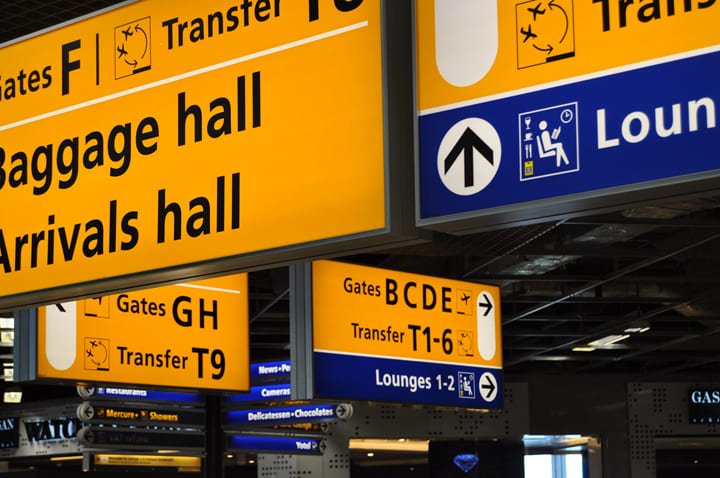
Before we get into the details of fonts and colors, let’s talk about the big “why.” Why do airports spend so much time and money on signs? Because good wayfinding does more than just help you find the restroom. It has a massive impact on how travelers feel, how well the airport runs, and even how much money it makes.
How Does Great Wayfinding Make Passengers Happier?
Saying Goodbye to Stress and Anxiety
Airports can be stressful places. You’re worried about time, you’re in a huge, crowded building, and you don’t know where anything is. This is where great signs come in to save the day. A clear, easy-to-understand wayfinding system is like a friendly guide holding your hand. It answers your questions before you even have to ask them, making you feel calm, confident, and in control. A recent survey showed just how much we depend on them, revealing that nearly 70% of all passengers rely on airport signage to find their way.
Catching Flights, Not Feelings of Panic
We’ve all had that nightmare of running through the airport to catch a flight. A clear path from the check-in counter, through security, and to the gate is essential for helping people manage their time. When passengers aren’t lost or confused, they don’t have to make those last-minute sprints. This is great for the airport, too! Fewer people missing flights means fewer delays and happier airlines.
Helping People Choose Their Next Trip
Here’s a surprising fact: good signs can actually influence where people decide to travel. One study found that an incredible 43% of travelers say that how easy an airport is to get around affects which flights they choose. An airport that is easy to navigate becomes a favorite, giving it a real advantage over other, more confusing airports.
What is the Impact of Wayfinding on How an Airport Works?
Keeping a River of People Flowing Smoothly
Imagine thousands of people all trying to get through the same security line at once. It would be a nightmare! A well-designed wayfinding system acts like a traffic controller for people. It spreads passengers out evenly, guiding them along different paths to prevent dangerous crowding and long lines, especially during busy holiday seasons.
Helping Shops and Restaurants Succeed
When you’re not stressed out and lost, what do you have? You have time! And when passengers have extra time, they are much more likely to grab a coffee, buy a book, or sit down for a meal. Clear signs that point the way to shops and restaurants directly help those businesses make more money. It’s simple: if people can’t find your store, they can’t buy anything from it.
Keeping Everyone Safe
Of course, the most important job of any airport is to keep people safe. Wayfinding is a huge part of this. Clearly marked “EXIT” signs and evacuation route maps are critical in an emergency. Some modern airports even have systems that can automatically close doors between areas to control movement if a security issue arises, showing how signage and security can work hand-in-hand.
The Evolution of Airport Wayfinding – A Journey Through Time
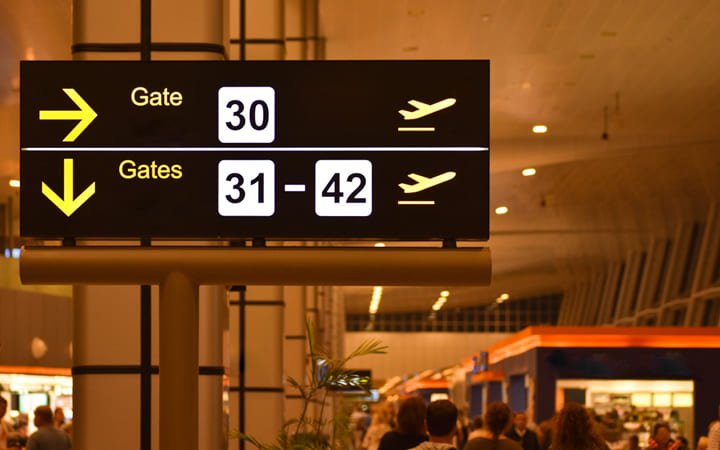
Airport signs haven’t always looked the way they do today. They have a fascinating history that has changed right alongside air travel itself. Let’s take a quick trip back in time to see how we got here.
From Simple Signs to a Global Standard
In the early days of flying, airports were small. A few simple, printed signs and a helpful staff member were all you needed. But as planes got bigger and more people started to fly in the 1960s and ’70s, airports grew into huge, complex buildings. The old ways weren’t enough. At first, each airline would put up its own signs, which led to a confusing mess of different styles and terms. Passengers were getting lost.
What is the “Schiphol Standard” and Why Does It Matter?
In 1967, something revolutionary happened at Amsterdam’s Schiphol Airport. They created the world’s first truly “passenger-first” signage system, and it changed everything.
The designers of the Schiphol system came up with a few brilliant, simple rules:
- Get rid of all the extra, unnecessary words on signs. Keep it simple!
- Use colors to mean different things. For example, they made all signs pointing to gates yellow, and all signs about baggage green. Your brain can understand a color much faster than it can read a word.
- Use simple pictures, or “pictograms.” A simple drawing of a man and woman is understood as “restroom” in every language. This was a huge help for international travelers.
This “Schiphol Standard” was so successful that it became the foundation for airport signs all over the world. It’s why, no matter if you’re in New York, Tokyo, or Dubai, you can usually understand the basic signs.
The Digital Takeover: From Flipping Boards to Giant Screens
Many of us remember the iconic sound of old airport departure boards—that constant “whir-spin-flap” as the letters and numbers flipped over to show new flight information. These old “Solari boards,” like the famous one that was recently retired at Singapore’s Changi Airport, were amazing pieces of technology in their day.
But today, we live in the digital age. Those flapping boards have been replaced by massive, super-bright LED and LCD screens called Flight Information Display Systems (FIDS). These digital walls can show tons of information at once and can be updated instantly. To see how far we’ve come, look at the new Istanbul Airport—it has the largest digital signage installation in the world, with over 700 giant Samsung screens!
The DNA of Great Wayfinding – Core Principles of Design
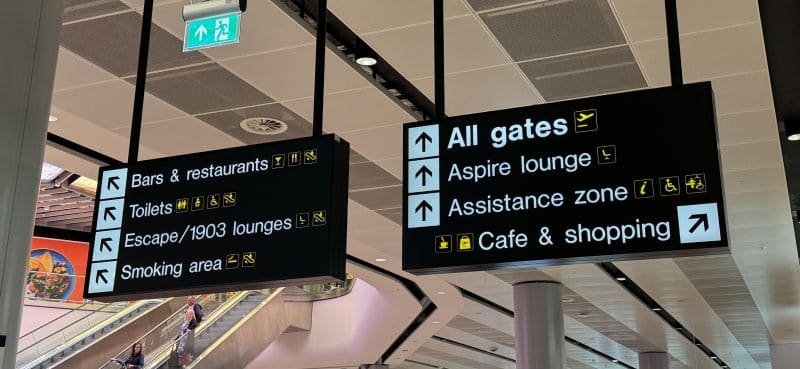
So, what makes one sign great and another one confusing? It’s not magic; it’s good design. There are a few core rules that all the best airport wayfinding systems follow to make sure their signs are as helpful as possible.
What are the Essential Ingredients of a Winning Wayfinding System?
Think of these as the building blocks of any great system:
- Clarity: The sign must be easy to understand in a split second. This means using simple words and avoiding confusing jargon.
- Consistency: This is a big one. The fonts, colors, and symbols used on the signs must be the same throughout the entire airport. If signs for gates are yellow in Terminal 1, they better be yellow in Terminal 4, too! This creates a predictable system that passengers can learn quickly.
- Visibility: A sign is useless if you can’t see it. Signs must be big enough, lit well enough, and placed at “decision points”—any place where a passenger has to make a choice about which way to go.
- Accessibility: The system must work for everyone. This includes people in wheelchairs, elderly travelers who might need bigger text, and people with vision impairments.
- Up-to-Date Information: The information must be correct. This is especially true for digital signs showing flight information. A good system is a reliable system.
How Should Airport Signs Be Designed to Be Easy to Read?
Legible Fonts and Simple Words
The text on a sign needs to be readable from far away and in all kinds of light. This means using clean, simple fonts (usually sans-serif fonts) and making the letters big enough. The words themselves should be simple and direct.
The Smart Use of Color
As we learned from the Schiphol Standard, color is a powerful tool. By using a consistent color code, airports can help passengers find what they’re looking for much faster. The brain processes color instantly, so you can spot the “yellow” gate signs from across the terminal without even reading the words.
The Power of Pictures (Pictograms)
Simple pictures and symbols are the universal language of airports. An icon of a telephone, a knife and fork, or a suitcase is understood by people from all over the world, no matter what language they speak. This is absolutely essential for making an international airport feel welcoming to everyone.
How Can We Use Science to Make Signs Even Better?
How do airports know if their signs are actually working? They can use science! Some airports, like London’s Heathrow, have used amazing eye-tracking technology to improve their signs. They had real passengers wear special glasses that tracked exactly where their eyes were looking as they walked through the terminal.
This allowed them to discover:
- Which signs people were looking at, and which ones they were completely ignoring.
- The exact spots where people got confused and hesitated.
- Areas where there were too many signs, creating “visual noise” and stress.
By using this data, they were able to make small changes to their signs that made a huge difference in helping passengers feel less frustrated and more confident.
The Wayfinding Toolkit – A Guide to Every Type of Airport Signage

Airport signs come in all shapes and sizes, and each one has a specific job to do. Let’s break them down into the main categories you’ll find in any airport.
| Signage Category | Its Main Job | Common Examples |
|---|---|---|
| Directional Signage | To point you in the right direction. | Signs with arrows pointing to “Gates A1-A15,” “Baggage Claim,” or “Ground Transportation.” |
| Informational Signage | To give you important information. | The big flight departure screens (FIDS), maps of the terminal, and signs at the gate with your flight details. |
| Regulatory Signage | To tell you the rules. | “No Smoking” signs, signs explaining the security process, and “Employees Only” signs. |
| Emergency Signage | To keep you safe in an emergency. | Brightly lit “EXIT” signs, and signs showing where fire extinguishers are located. |
Directional Signage: The Signs That Point the Way
This is the backbone of the entire wayfinding system. These signs are all about getting you from Point A to Point B. They use clear words and, most importantly, arrows. The arrow is a simple, universal symbol that everyone understands. These signs guide you to your terminal, your gate, the baggage claim, the restrooms, and the exit.
Informational Signage: The Signs That Tell You What You Need to Know
These signs give you the facts. The most important informational signs are the huge Flight and Baggage Information Displays (FIDS and BIDS). These digital screens are constantly updated with flight times, gate numbers, and which carousel your luggage will be on. This category also includes the big “You Are Here” maps of the airport.
Advertising as Wayfinding: The Sneaky Helper
Here’s a cool idea: even the ads in an airport can help you find your way! A big, bright sign for Starbucks or McDonald’s doesn’t just make you want a coffee or a burger. It also acts as a landmark. If you know the Starbucks is near your gate, seeing that sign can reassure you that you’re going the right way. These signs help passengers find amenities while also making money for the airport’s shops.
Static vs. Digital Signs: A Head-to-Head Matchup
Airports use a mix of old-school static signs and new-school digital signs. Here’s a look at the pros and cons of each.
| Type of Sign | Pros (What’s Great About It) | Cons (What’s Not So Great) |
|---|---|---|
| Static Signage (Regular printed signs) | Very reliable (it always works!), cheaper to make, doesn’t need electricity. | Can’t be changed easily. If a gate moves, the sign is wrong. |
| Digital Signage (Screens and displays) | Can be updated instantly, can show moving pictures and multiple languages, very bright and eye-catching. | More expensive, needs power and technology to work (and can sometimes break down). |
So which is better? Neither! The best strategy is a mix of both. Airports use reliable static signs for things that don’t change, like pointing to the restrooms or exits. And they use flexible digital signs for information that changes all the time, like flight gates and wait times.
The Digital Revolution in Airport Wayfinding
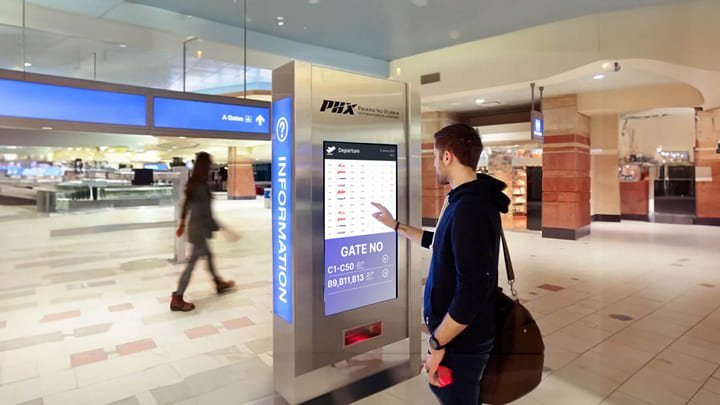
Technology has completely changed the way we find our way around airports. Let’s look at some of the cool digital tools that are making travel easier than ever.
Digital Wayfinding Kiosks: Your Personal Info Booth
You’ve probably seen these in malls and airports. They are large, interactive touch-screen displays that act like a digital information desk. You can walk up to one, touch the screen to pull up a map of the airport, search for a specific store or your gate, and it will show you exactly how to get there. Some even have features to lower the screen interface, making them accessible for people in wheelchairs.
Mobile Apps: An Airport Guide in Your Pocket
Almost every major airport now has its own mobile app that you can download to your phone. These apps are like having a personal tour guide. Using the GPS and Bluetooth signals in the airport, they can figure out exactly where you are and give you turn-by-turn walking directions to your destination. But like any technology, they have their good and bad sides.
| Pros of Using an Airport App | Cons of Using an Airport App |
|---|---|
| It’s Personal: It knows your flight and can guide you right to your gate. | Needs Technology: You need a smartphone and an internet connection. |
| Real-Time Info: It can warn you about gate changes or long security lines right away. | Uses Battery and Data: The app can drain your phone’s battery quickly. |
| Extra Features: You can use it as your boarding pass or to order food. | Privacy Concerns: Some people worry about the app tracking their location. |
| Accessibility: Many have voice guidance for visually impaired travelers. | Can Be Confusing: For people who aren’t tech-savvy, using the app can be stressful. |
From Guide-Bots to Parallel Reality: What’s Next?
The future is already here in some airports!
- Robots: Airports in places like Incheon, South Korea, have experimented with friendly robots that can roll up to you, scan your boarding pass, and either tell you or physically lead you to your gate.
- Parallel Reality: This sounds like science fiction, but it’s real! Delta Air Lines is testing a technology where one giant screen can show personalized flight info to dozens of different people at the same time. You look at the screen and see your flight info, while the person next to you looks at the same screen and sees their completely different flight info. Amazing!
The Airport as a Journey – Wayfinding Through Different Zones

A passenger’s trip through an airport happens in stages. The kind of information they need changes as they move from one zone to the next.
The Arrival: Getting to the Airport (Landside)
Your airport journey doesn’t start inside the terminal; it starts on the road. The wayfinding system needs to begin miles away, with clear highway signs guiding people to the airport exit. Once on airport property, there needs to be clear signage for the different terminals, parking garages (short-term vs. long-term), rental car returns, and passenger drop-off areas.
The Transition: Getting Through Check-In and Security
This is the first big hurdle. Once inside, passengers need to be guided to the correct airline check-in desks. After that, signs must clearly point the way to the security screening area, which can often be a confusing and stressful process.
The Exploration: Hanging Out in the Departure Lounge (Airside)
After you get through security, your mindset changes. You’re no longer in a huge rush. Now you have time to kill. The wayfinding in this “airside” zone is designed to help you find your gate, but also to help you discover all the amenities the airport has to offer, like restrooms, lounges, food courts, and shops.
The Final Mile: Navigating the Tarmac
Here’s something most of us never think about: the “backstage” area of the airport also has its own complex wayfinding system! The tarmac—the area where planes park and drive—is covered in a confusing-looking pattern of lines and numbers. These markings are actually a highly organized system of roads and signs for the ground crew, fuel trucks, and baggage carts to navigate safely around the massive airplanes.
From Theory to Practice – Creating a Winning Wayfinding Strategy

So how does an airport put all of this together to create a system that works? It takes a lot of careful planning. It’s not as simple as just putting up a few signs.
How Do You Create a Wayfinding Strategy That Will Last?
Airport planners follow a step-by-step process:
- Study What You Have: First, they do a full check-up of the current signage system to see what’s working, what’s broken, and what’s confusing.
- Think About the User: They have to design for everyone—from the busy business traveler to a family with small children to an elderly person who needs extra help.
- Mix in Technology: They decide how to blend digital tools like kiosks and apps with the traditional signs to get the best results.
- Plan for the Future: Airports are always changing and growing. A good system needs to be flexible so it can be easily updated when a new wing is built or a terminal is renovated.
- Listen to Feedback: The best way to know if your system is working is to ask the people who use it! Airports can use surveys or QR codes on signs to get feedback from passengers to help them constantly improve.
What Are the Biggest Challenges and How Do Airports Solve Them?
- The Challenge: Airports are huge and have very complex layouts.The Solution: A super consistent and simple signage system. Use the same colors, fonts, and symbols everywhere so passengers can learn the “language” of the airport quickly.
- The Challenge: People from all over the world who speak many different languages use the airport.The Solution: Use lots of universal pictures (pictograms)! Also, digital signs are great for this because they can be programmed to show information in many different languages, sometimes even changing automatically based on where the next flight is going, like they do at Prague Airport.
- The Challenge: Too much information at once can be overwhelming.The Solution: The “less is more” rule. A sign should only give you the information you need at that exact spot. Don’t try to put a map of the entire airport on every single sign.
The Future of Airport Navigation
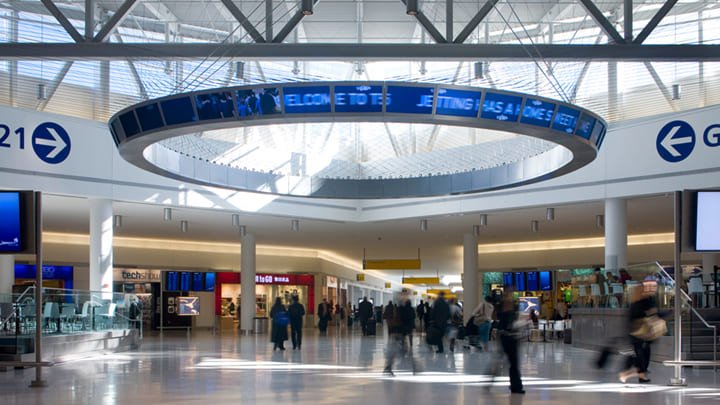
What will finding our way through an airport look like in the future? It’s going to be even more personal and high-tech.
What Will Wayfinding Look Like in the Next 10 Years?
- Augmented Reality (AR): Imagine holding up your phone and seeing digital arrows overlaid on the real world, guiding you directly to your gate.
- Artificial Intelligence (AI): Smart systems could predict where crowds are forming and suggest alternative, less congested routes to passengers in real-time.
- Sustainability: A greater focus on eco-friendly materials for static signs and energy-efficient, long-lasting digital displays.
- Integration with Wearables: Getting directions and updates sent directly to your smartwatch for hands-free navigation.
Conclusion: The Silent Guide of the Skies
As we’ve seen, airport wayfinding has grown from a few simple signs into a complex, technology-driven science. Its goal is not just to direct, but to create a seamless, stress-free, and safe experience.
An airport’s signage system is its silent concierge, its ever-present guide, and its most crucial tool for operational success. By embracing clear design, smart technology, and a passenger-first mindset, airports can turn a potentially stressful journey into the smooth and exciting start of a new adventure.
Planning a Wayfinding System? Let’s Talk!
Frequently Asked Questions
- What is the most important element of airport wayfinding?
- Clarity and consistency are the most important parts. The signs must be easy to understand at a glance, and they must use the same style (colors, fonts, symbols) throughout the entire airport so passengers don’t get confused.
- Why do airports use so many symbols and pictograms?
- Because airports are used by people from all over the world who speak many different languages. Simple pictures, or “pictograms,” are a universal language that everyone can understand.
- What is the difference between landside and airside wayfinding?
- “Landside” refers to the parts of the airport that are open to the public, before you go through security (like check-in desks and baggage claim). “Airside” is the secure area of the airport after you pass through security, which includes the departure gates and lounges.
- How do airport apps know where I am inside the building?
- They use a combination of technologies! They can use the airport’s Wi-Fi network and small, low-energy Bluetooth devices called “beacons” that are placed around the terminal. Your phone picks up these signals, and the app uses them to pinpoint your location on its map.
- Are digital signs going to completely replace regular signs in airports?
- Probably not completely. While digital signs are perfect for changing information like flight details, regular static signs are still very reliable, cost-effective, and don’t need power to work. The best systems use a smart mix of both.