The Silent Concierge: A Deep Dive into Hotel Signage Types
Hotel signage isn’t a one-size-fits-all category. It’s a complex ecosystem of different signs, each with a specific job. Thinking of it this way helps you build a cohesive system that guides, informs, and reassures your guests from the moment they arrive until they check out.
Exterior Signage: The First Hello
This is your handshake with the world. Exterior signs are the first physical touchpoint for your guests and a 24/7 advertisement for your brand. They must be visible, durable, and perfectly aligned with your hotel’s character.
- Monument & Pylon Signs: These large, freestanding signs at the property entrance are beacons for drivers. They need to be legible from a distance and often incorporate lighting for nighttime visibility.
- Building Identification: These are the main signs on the hotel facade, proudly displaying your name and logo. The choice of materials and lighting here makes a powerful statement about your brand’s quality.
- Directional & Parking Signs: Don’t let the guest journey start with frustration. Clear, logical signs for entrances, exits, parking garages, and valet services create a smooth, stress-free arrival.
Interior Wayfinding Signage: The Guiding Hand
Once inside, guests enter a new environment. Your wayfinding system is their map, helping them navigate with ease and confidence. The goal is to create a “breadcrumb trail” that intuitively leads them where they need to go.
- Lobby Directories: A central hub of information, listing the locations of key amenities like restaurants, the spa, conference floors, and the fitness center.
- Directional Signs: Placed at key decision points like elevator lobbies and hallway intersections, these signs use arrows and clear text to point the way. Consistency in design is crucial here.
- Overhead Signs: In large, open spaces like convention centers or sprawling resort corridors, suspended signs are essential for long-distance visibility.
Identification Signage: Giving Every Space a Name
These signs confirm a guest has arrived at their destination. From their room to the pool, identification signs provide clarity and reinforce the hotel’s design aesthetic at a micro-level.
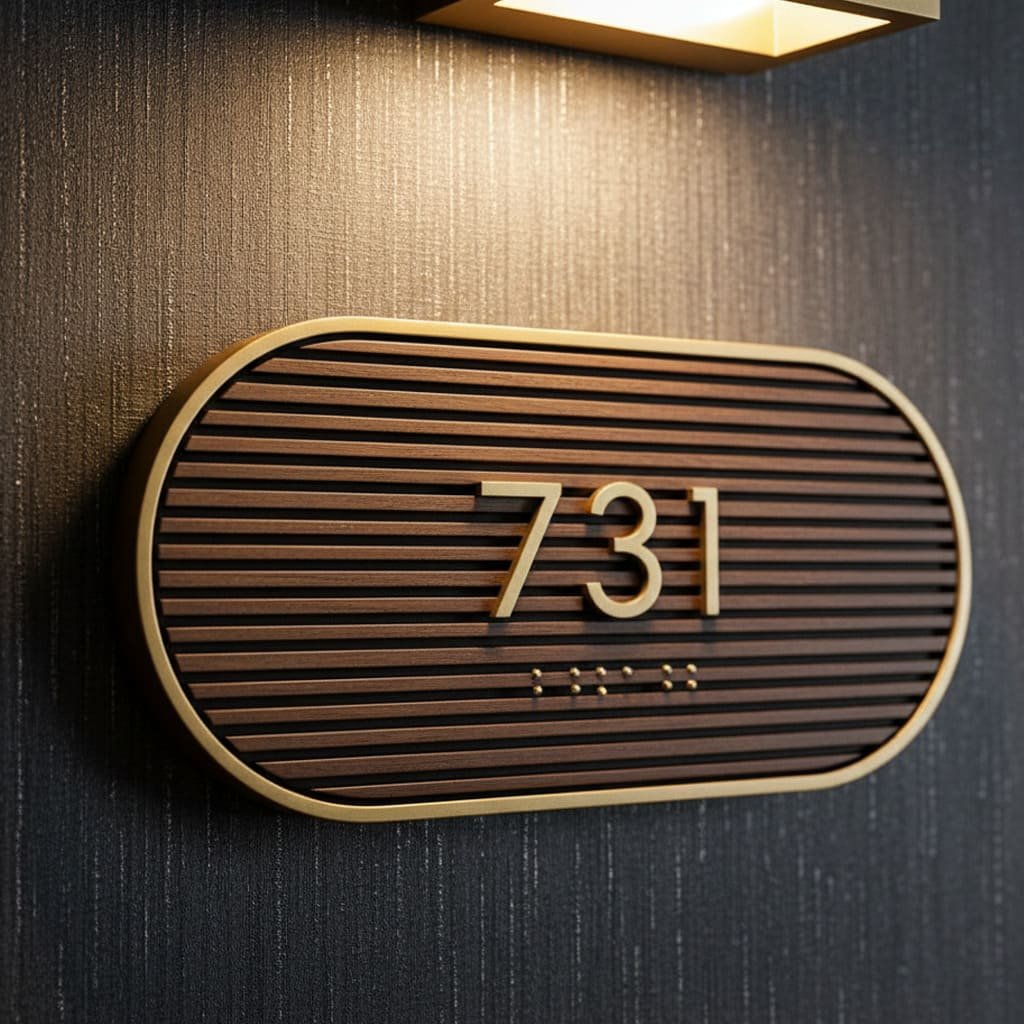
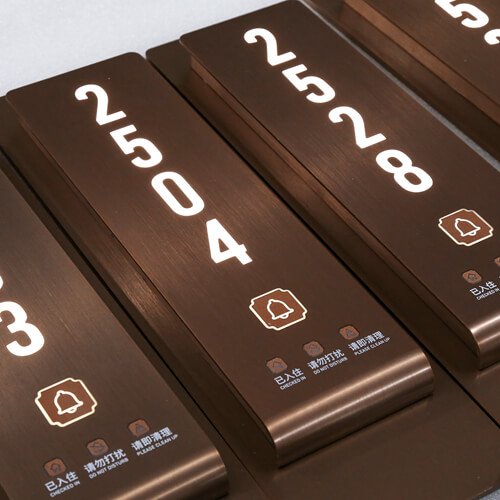
- Room & Suite Numbers: This is perhaps the most personal sign a guest interacts with. The design, material, and finish of a hotel door number can convey luxury, modernity, or boutique charm.
- Amenity Signs: Clearly labeling the “Spa,” “Fitness Center,” “Pool,” and “Business Center” helps guests discover and use the facilities you offer.
- Conference & Meeting Rooms: Professional and easily updatable signs (sometimes digital) are a must for business travelers.
Regulatory & Safety Signage: The Unseen Guardian
While often overlooked from a design perspective, this category is non-negotiable. These signs ensure the safety and accessibility of all guests and keep your property compliant with local and federal laws, such as the
Americans with Disabilities Act (ADA).
- ADA-Compliant Signs: These require specific features like tactile lettering, Braille, non-glare finishes, and precise mounting heights. They are essential for restrooms, room numbers, and permanent spaces.
- Fire & Emergency Signs: This includes illuminated exit signs, evacuation maps posted on the back of room doors, and signs for fire extinguishers and emergency exits. Their clarity can be life-saving.
“Think of your signage system as part of your staff. A great sign anticipates a guest’s question and answers it before it’s even asked. It’s proactive hospitality.”
| Quick Guide to Signage Categories |
| Category |
Primary Function |
Key Examples |
Impact on Guest |
| Exterior |
Attraction & First Impression |
Monument Sign, Building Logo |
Builds brand recognition and eases arrival. |
| Wayfinding |
Navigation & Direction |
Lobby Directory, Hallway Signs |
Reduces stress and encourages exploration. |
| Identification |
Confirmation & Branding |
Room Numbers, Spa Sign |
Provides clarity and reinforces design details. |
| Regulatory |
Safety & Compliance |
ADA Restroom Signs, Exit Signs |
Ensures a safe and accessible environment for everyone. |
More Than a Marker: How Signage Shapes the Guest Journey
Effective hotel signage does more than just point the way; it actively enhances the guest experience at every turn. When you invest in a thoughtful signage strategy, you’re investing in guest satisfaction, brand loyalty, and even your bottom line.
Seamless Navigation and Reducing Guest Anxiety
Imagine arriving at a sprawling resort after a long flight, tired and with family in tow. The last thing you want is a confusing search for the check-in desk. Clear, intuitive signage immediately lowers stress levels. It empowers guests, giving them the confidence to explore your property. They’re more likely to find—and spend money at—the rooftop bar, the gift shop, or the fine-dining restaurant if they don’t feel intimidated by the layout. A well-signed property feels manageable, welcoming, and thoughtfully designed around the guest’s needs.
Reinforcing Your Brand Story at Every Touchpoint
Your brand is more than just a logo. It’s a story, a feeling, a promise. Every sign is an opportunity to tell that story.
Are you a luxury hotel? Polished brass signs with elegant, serif typography whisper sophistication.
Are you a trendy, modern brand? Sleek, backlit acrylic signs with minimalist fonts scream cutting-edge.
Are you an eco-conscious retreat? Signs made from reclaimed wood or natural slate connect guests to your values.
This consistency creates a powerful, immersive brand experience. When the design language of the signage matches the architecture, the decor, and the service, it builds a cohesive world for your guests to inhabit.
Ensuring Safety and Building Trust
Proper safety and accessibility signage is about more than just avoiding fines. It is a powerful, unspoken message to your guests: “We care about you. Your safety and comfort are our top priority.” When a guest with a visual impairment can easily find their room using an ADA-compliant sign, or a family can quickly locate the nearest exit during a fire alarm, you have built a foundation of trust. This feeling of being cared for is the bedrock of true hospitality and a key driver of repeat business.
Driving Revenue by Showcasing Amenities
Signage is a powerful, yet subtle, sales tool. A generic sign that says “Restaurant” is functional. But a beautifully designed sign featuring the restaurant’s logo, perhaps with a tagline like “Authentic Italian Cuisine | Open for Dinner,” does much more. It piques interest and plants a seed. Strategically placed signs for your spa, gift shop, or special event spaces can significantly increase their visibility and usage, turning passive guests into active consumers of your hotel’s full range of services.
The Language of Materials: Choosing the Perfect Look and Feel
The material you choose for your signage is its core identity. It determines its look, its feel, its durability, and its cost. As a designer or procurement manager, I’ve learned that the right material choice is a balance of aesthetics, environment, and budget. It’s about finding the perfect fit for your hotel’s story and its physical demands.
Classic Metals: Timeless Elegance and Durability
Metals are a popular choice in hospitality for their premium feel and robust nature. They can be shaped, finished, and combined in countless ways.
- Stainless Steel: A modern workhorse. It’s incredibly durable, corrosion-resistant, and easy to maintain. A brushed finish offers a sophisticated, contemporary look, while a polished finish provides a mirror-like shine. It’s perfect for high-traffic areas like lobbies and elevators.
- Brass & Bronze: The gold standard for luxury. These materials exude a classic, warm elegance that is synonymous with high-end hotels. They develop a natural patina over time, which can be a desired effect, or can be sealed to maintain their original luster.
- Aluminum: Lightweight, versatile, and more cost-effective than steel or brass. It can be anodized or powder-coated in any color, making it a fantastic choice for large exterior signs and for matching specific brand colors.
Versatile Synthetics: Modern Design and Affordability
Modern plastics and acrylics offer immense design flexibility and can be a great budget-conscious alternative to metal without sacrificing style.
- Acrylic (Plexiglas): Lightweight, shatter-resistant, and available in countless colors and finishes (clear, frosted, opaque). It’s excellent for creating layered signs and is the perfect material for backlighting with LEDs to create a stunning glow effect.
- PVC: A cost-effective and durable plastic often used for back-of-house or less prominent regulatory signs. It’s easy to print on and can be cut into custom shapes.
Natural Elements: Warmth and Authenticity
For hotels aiming for a boutique, rustic, or eco-friendly vibe, natural materials can create a unique and memorable connection with guests.
- Wood: From dark walnut to light maple, wood adds unparalleled warmth and character. It can be carved, engraved, or used as a backplate for metal lettering. It’s best suited for interior applications or protected exterior areas.
- Stone: Materials like slate, marble, or granite can be used for monument signs or high-end accent signs, providing a sense of permanence and organic luxury.
| Hotel Signage Material Comparison |
| Material |
Aesthetic |
Best For |
Durability |
Relative Cost |
| Stainless Steel |
Modern, Sleek, Clean |
Lobbies, Elevators, Exteriors |
Very High |
$$$ |
| Brass/Bronze |
Luxury, Classic, Warm |
High-end Room Numbers, Main Entrances |
High (patinas over time) |
$$$$$ |
| Aluminum |
Versatile, Customizable |
Large Exterior Signs, Wayfinding |
High |
$$ |
| Acrylic |
Contemporary, Colorful |
Backlit Signs, Directories, Logos |
Medium |
$$ |
| Wood |
Warm, Rustic, Boutique |
Interior Room Numbers, Spa Signage |
Medium (indoor use) |
$$$ |
A Signature Style: Aligning Signage with Your Hotel’s Identity
Your signage shouldn’t feel like a separate element; it must be an integral part of your hotel’s architectural and interior design. Consistency is key. Every sign, from the parking garage to the penthouse, should speak the same visual language. Let’s explore how to tailor your signage to fit your specific brand archetype.
The Urban Luxury Hotel: Sophistication and Prestige
For a five-star hotel in a major city, the signage needs to convey opulence and timeless elegance.
- Materials: Think polished brass, dark bronze, or gold-plated finishes. Consider combining these with rich materials like marble backplates or dark, lacquered wood.
- Typography: Classic serif fonts like Trajan or Garamond project a sense of history and establishment. Custom, elegant script fonts can add a bespoke touch.
- Lighting: Subtle halo lighting behind metal letters creates a soft, sophisticated glow. Pinpoint spotlights can be used to highlight key signs.
The Sleek Modern Hotel: Minimalist and Tech-Forward
For a contemporary hotel focused on clean design and efficiency, the signage should be crisp, uncluttered, and functional.
- Materials: Brushed stainless steel and frosted or clear acrylic are the go-to choices. Look for clean, sharp edges and minimal hardware.
- Typography: Sans-serif fonts like Helvetica, Futura, or Gill Sans are a perfect match. The focus is on legibility and geometric purity.
- Lighting: Integrated LED face-lighting or edge-lighting is a hallmark of this style. Digital displays for directories and meeting rooms also fit perfectly here.
The Charming Boutique Hotel: Unique and Artisanal
Boutique hotels thrive on personality and a one-of-a-kind atmosphere. The signage should reflect this handcrafted, intimate feel.
- Materials: Reclaimed wood, wrought iron, slate, or even custom ceramics can be used. Embrace imperfections and unique textures.
- Typography: Hand-painted lettering, custom-designed fonts, or even vintage-style typography can add immense character.
- Details: Consider non-traditional shapes, engraved patterns, or incorporating the hotel’s unique logo or motif in a creative way on each sign.
| Matching Signage Style to Hotel Brand |
| Hotel Type |
Core Vibe |
Key Materials |
Typography Style |
| Luxury Grandeur |
Elegant, Timeless, Opulent |
Polished Brass, Bronze, Marble |
Classic Serifs, Custom Scripts |
| Modern Minimalist |
Clean, Sleek, Efficient |
Brushed Steel, Frosted Acrylic |
Geometric Sans-Serifs |
| Boutique Charm |
Artisanal, Unique, Personal |
Reclaimed Wood, Wrought Iron, Slate |
Hand-painted, Vintage, Bespoke |
| Family Resort |
Fun, Durable, Welcoming |
Colored Aluminum, Weather-Resistant Composites |
Bold, Rounded, Legible |
Your Strategic Blueprint: Key Factors Before You Buy
Making a significant investment in a complete hotel signage package requires careful planning. Before you even contact a supplier, you need to have a clear understanding of your project’s requirements. Answering these questions upfront will save you time, money, and headaches down the road.
Durability and Maintenance: A Long-Term View
A sign might look beautiful on day one, but how will it look after 50,000 guests have walked past it?
- For High-Traffic Areas: Lobby signs, elevator panels, and main corridor signs need to be tough. Choose materials that resist scratches, fingerprints, and dents, like 304-grade stainless steel.
- For Exteriors: Outdoor signs must battle the elements. Ensure materials are rated for UV resistance to prevent fading, are corrosion-proof (especially in coastal areas), and can withstand wind and temperature changes.
- Ease of Cleaning: How will your housekeeping staff maintain the signs? Some finishes show fingerprints more than others. Will they require special cleaning agents? Factoring this into your decision affects long-term operational costs.
Visibility and Legibility: Clarity is King
A sign is useless if it can’t be read. This seems obvious, but it’s a common oversight.
- Color Contrast: There must be a significant contrast between the text and the background for easy reading. This is also a key requirement for ADA compliance.
- Font Choice & Size: The font must be clear and legible from the intended viewing distance. A highly stylized font might look great up close but become an unreadable blur from 20 feet away.
- Lighting Conditions: How will the sign look in bright daylight versus dim evening light? This is where backlighting or dedicated spotlights become crucial for 24/7 readability.
Customization and Brand Consistency
Your signage needs to be a perfect reflection of your brand guide.
- Color Matching: Can the supplier precisely match your brand’s specific Pantone colors? Ask for color swatches on your chosen material.
- Architectural Integration: The signs should look like they belong. Provide your supplier with architectural drawings and interior design plans so they can recommend sizes, placements, and mounting methods that complement the space.
From my experience, the biggest mistake is underestimating the project’s complexity. A successful signage project begins with a detailed plan, not a rushed purchase order.
Finding Your Partner: Collaborating with a Signage Manufacturer
Choosing the right manufacturer is the single most important decision in your signage project. A great partner acts as a consultant, guiding you through the process, while a poor one can lead to delays, budget overruns, and a subpar product. For large-scale hotel projects, working with an experienced, large-scale manufacturer, often based in a production hub like China, offers benefits in quality, cost, and customization.
Step 1: The Vetting Process – Who Can You Trust?
Don’t just look for the lowest price. Look for proof of expertise.
- Ask for a Hospitality Portfolio: Have they worked with hotel brands similar to yours? Ask to see case studies and photos of their completed projects.
- Check Their Capabilities: Do they have in-house capabilities for the materials and finishes you need? A manufacturer that controls the entire process, from metal fabrication to electrical wiring, will have better quality control.
- Request Client References: A confident and reputable supplier will be happy to connect you with past clients. Speaking to another hotel procurement manager about their experience is invaluable.
Step 2: The Briefing – Clarity is Your Best Friend
The quality of your final product is directly related to the quality of your initial brief. Provide as much detail as possible.
- Technical Drawings: Architectural plans, elevations, and detailed sign designs with dimensions.
- Brand Guidelines: Your complete brand book with logos, fonts, and color codes (Pantone, CMYK).
- Material Specifications: Be specific. Instead of “metal,” specify “304 stainless steel with a brushed finish and anti-fingerprint coating.”
- Mood Board: A visual collection of images that captures the look and feel you are aiming for.
Step 3: The Sampling and Prototyping Phase – Never Skip This!
A 3D render on a computer screen cannot replicate the look and feel of a physical object. Insist on a physical sample or prototype before authorizing mass production. This is your chance to:
- Check the Quality: Assess the weight, finish, and construction.
- Verify the Colors: Ensure the colors match your brand guide under real lighting conditions.
- Test the Lighting: If your sign is illuminated, check for brightness, color temperature, and any “hot spots.”
This step might add a few weeks to your timeline, but it can save you from a costly and irreversible mistake.
Demystifying the Numbers: A Realistic Hotel Signage Budget Breakdown
Budgeting for a full hotel signage package can be complex. The total cost is influenced by materials, quantity, complexity, and logistics. Understanding the different cost components will help you create a realistic budget and make informed decisions.
Think of your budget in four main categories: the signs themselves (manufacturing), the costs to get them to you (logistics), the cost of installing them, and the hidden costs of long-term ownership.
| Sample Budget Allocation for a Mid-Sized Hotel Signage Project |
| Cost Category |
Description |
Estimated % of Total Budget |
| Design & Prototyping |
Initial design fees (if not in-house), creation of physical samples. |
5% – 10% |
| Manufacturing |
The raw materials, labor, finishing, and illumination for all signs. This is the bulk of the cost. |
50% – 65% |
| Logistics & Shipping |
Crating, freight (sea or air), insurance, customs duties, and taxes. |
10% – 20% |
| Installation |
On-site labor, equipment rental (lifts, etc.), electrical work, and permits. |
10% – 15% |
| Contingency |
A buffer for unexpected issues, design changes, or shipping delays. |
5% – 10% |
Remember, prioritizing quality upfront is a smart financial decision. A cheaper acrylic sign might save you 30% now, but if it cracks and needs to be replaced in two years, you’ve lost money. A high-quality brass sign, while more expensive initially, can last for decades, making it a better long-term investment in your brand’s image.
The Project Timeline: From Concept to Flawless Installation
One of the most common pitfalls in hotel development is ordering signage too late. Quality, custom signage is not an off-the-shelf product; it requires a detailed manufacturing and logistics process. Planning your signage procurement early in the construction schedule is essential to ensure it’s on-site and ready for installation before your grand opening.
Here is a realistic timeline for a typical international hotel signage project. Use this as a guide to plan backward from your hotel’s opening date.
| Typical Hotel Signage Project Timeline |
| Phase |
Key Activities |
Typical Duration |
| Phase 1: Planning & Design |
Finalizing sign list, designs, materials; selecting a manufacturer. |
3 – 4 Weeks |
| Phase 2: Sampling & Approval |
Manufacturer produces physical samples; you provide feedback and final sign-off. |
2 – 3 Weeks |
| Phase 3: Mass Production |
The factory manufactures, finishes, and assembles the full order. |
4 – 7 Weeks |
| Phase 4: Logistics & Shipping |
Professional packaging, booking freight, ocean/air transit, customs clearance. |
3 – 6 Weeks |
| Phase 5: Installation |
On-site installation and final quality check before hotel opening. |
1 – 2 Weeks |
| Total Estimated Time |
|
13 – 22 Weeks |
Your mantra should be: “Plan early.” The timeline is your roadmap. If you start the process 6-8 months before your opening date, you give yourself a comfortable buffer for any unforeseen challenges.
Safe and Sound: Navigating Global Shipping and Packaging
Your beautifully crafted signs are finished… and now they have to travel thousands of miles across an ocean. The final, and often most stressful, phase of procurement is logistics. A damaged shipment can cause catastrophic delays to your hotel opening. Protecting your investment during transit is paramount.
Insist on Expert Packaging
Don’t leave packaging to chance. Specify your requirements with the manufacturer.
- Custom Wooden Crates: For international shipping, anything less than sturdy, export-grade wooden crates is a risk. Each crate should be custom-built for the signs it holds.
- Internal Protection: Inside the crate, each sign should be individually wrapped in soft foam or bubble wrap. Custom-cut foam inserts should be used to prevent any movement or vibration during transit.
- Clear Labeling: Every crate must be clearly labeled with handling instructions (“Fragile,” “This Way Up”), the contents, your project name, and the final destination address. This is crucial for both the shipping company and the team on your construction site.
Understand Your Shipping Options
You generally have two choices for international freight:
- Sea Freight: Far more cost-effective, especially for large, heavy orders. However, it is much slower, taking several weeks. This is the best option if you have planned your timeline well.
- Air Freight: Much faster, often taking just a week. However, it is significantly more expensive. This is typically reserved for rush orders or for sending replacement samples quickly.
Don’t Forget Insurance and Customs
Always ensure your shipment is fully insured against damage or loss. Work with a manufacturer or a freight forwarder who can handle all customs documentation smoothly to avoid delays at the port of entry. A reliable supplier will have a dedicated logistics team to manage this entire process for you.
Sidestepping Pitfalls: Common Mistakes and How to Avoid Them
Over the years, I’ve seen the same preventable mistakes derail hotel signage projects. By learning from them, you can ensure your project runs smoothly from start to finish.
Mistake 1: Treating Signage as an Afterthought.
The Fix: Integrate signage planning from the beginning. Discuss signage during the initial architectural and interior design phases. This ensures the signs are a cohesive part of the design, not a “stuck on” solution. It also allows you to build the necessary electrical and mounting infrastructure into the walls.
Mistake 2: Prioritizing Initial Cost Over Long-Term Value.
The Fix: View signage as a brand asset. Choosing a cheaper material that quickly fades, tarnishes, or breaks will cost you more in replacements and will damage your brand’s premium image. Invest in quality materials that align with your hotel’s standards and will stand the test of time.
Mistake 3: Working with an Inexperienced Supplier.
The Fix: Vet your suppliers rigorously. Choose a manufacturer with a proven track record in the hospitality industry. An experienced partner will understand the specific demands of a hotel environment, from durability needs to ADA regulations. They will be a problem-solver, not just an order-taker.
Mistake 4: Skipping the Physical Sample.
The Fix: Always demand a prototype. You cannot judge the quality of a finish, the warmth of an LED light, or the weight of a material from a picture. A physical sample is your ultimate quality assurance check. It is the best money you will spend in the entire process.
Mistake 5: Underestimating Logistics.
The Fix: Build a generous buffer into your timeline. International shipping can face unexpected delays—from port congestion to customs inspections. Assuming a best-case scenario is a recipe for stress. Plan for the worst and be pleasantly surprised when your shipment arrives early.
Ready to Elevate Your Hotel’s Guest Experience?
Hotel signage is a critical investment in your brand’s identity and your guests’ satisfaction. By choosing the right materials, planning strategically, and partnering with an experienced manufacturer, you can create a signage system that is both beautiful and flawlessly functional.
If you’re planning a new hotel project or a renovation, let’s talk. Our team of specialists is ready to help you navigate every step, from custom design to global delivery, ensuring your vision is brought to life with precision and quality.